

Under the shades of a tropical forest there has been a tree that has been there in the past 100 or more years undergoing the heat of the sun, the moisture of the rain, and the cool breeze of the wind. Its wood does not just run into the industry when harvested. Rather, it gets involved in a transition offended by fire and silence and time. This is how common wood into charcoal: the process of carbonizing, the raw material transformed to the basic energy.
The beginning of wood into charcoal: Wood as the source of all potential
It starts by a selection- not all wood is equal. The strength of the wood is determined by its density, age, and moisture content and how it is going to withstand the heat that is going to be encountered.
Species like teak, oak and ironwood are hardwoods that bear close embraced fibers and therefore best in long burning, compact charcoal. These woods form the backbone of lump charcoal and even high end products such as Binchotan.
Softwoods, such as eucalyptus, lychee or coffee tree, on the other hand light quicker, burn more ash, and usually have lower density charcoal.
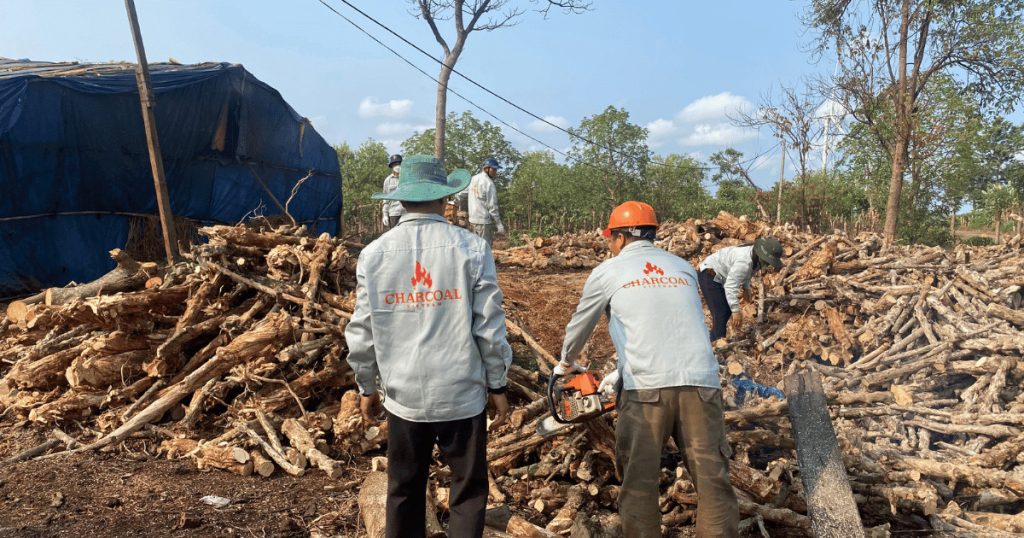
Wood will have to encounter the sun before encountering the fire. In open yards logs are arranged in a manner that wind and sunlight take time to dry the logs. The evaporational sound starts quietly invisibly when the water escapes the fibers. The moisture level will have to be considerably low before carbonization or a lot of heat will go into boiling water instead of accumulating carbon. When good charcoal is promised, it is in the ideal billet, dry, dense and smooth.

Into the fire: Traditional and modern carbonization in producing wood into charcoal
Once the sun has worked its magic the wood goes to the kiln. In this case, it is a mixture of science and tradition. There now are two directions–one old-fashioned and earthy, the other modern and exact, but both based on the same principle: burn slowly and with practically no oxygen so that the wood does not turn into fire, but coal.
In the conventional brick-kilns, the logs are loaded tightly and burned with a small opening. The mouth would then be covered so that air would be left only to maintain a smoldering burn. And the fire mauvers along the room in a three weeks, abbating smoke through fissures, blackening the timber inwardly. Employees do not only listen with their ears, but instinctively, they know by looking by color, smell, feeling the heat, when a batch is ready to come off. The charcoal derived makes an average 13 to 15 items of tonnage colloquial to 60 to 70 tons of wood. The end product can be of lesser quality but the original shape and soul of the wood has been kept.
The story is however different under modern carbonization. In this case, wood or sawdust are obtained and pressed out in the form of identical briquettes. These are inserted in closed kilns fitted with sensors and airflow systems. The flame has been domesticated and the heat is controlled. The cycle is only between 5 and 7 days and makes clean, standardized charcoal. Emissions are kept to a minimum and consistency is achieved. The precision is introduced by technology, but it is just the same: a slow waltz with fire in the ainesspace.

Transformation: The charcoal that emerges
Not every charcoal may emerge out of the kiln in the same shape. Similar to other students of the same school, every form has its own purpose in this world.
Lump charcoal comes out in a raw and proud way with uneven form and its imprints. It does not burn cool, does not take long to light up and pesters a few ashes. Having a preference with grill masters and chefs it is nothing more than an extension of the forest.
Binchotan on the contrary is a disciplined child. On being heated to above 1,000 of Fahrenheit, and immediately cooled in a bed of sand or ash, it is thenceforth transformed into white charcoal,–pure and free, and of a non-offensive odour, nearly metallic when struck. Every work is made out of stone: thick and clean and permanent. Made in Vietnam as well as Japan, where it is highly appreciated in the finest restaurants, Binchotan cannot in any circumstances interact with flavor.
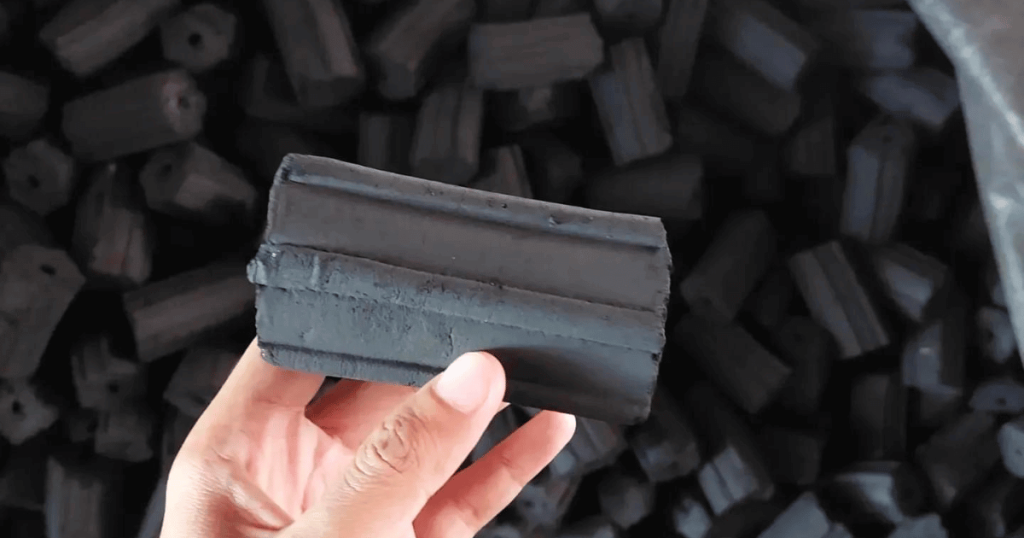
Next is the renaissance of the briquette, sawdust charcoal. It is square, economical and specialized to be made of sawdust pressed together and afterward carbonized. It does not emit sparks or smoke, which makes it perfect to be used in industrial kitchens and environment-friendly brands. No chemicals, no add-ons – just clever exploitation of leftovers, which are turned by ordered heat.
Every distinctive kind of charcoal talks about intention. With the same process, however, different hands breed different fates.
Conclusion
Transforming wood into charcoal is an exercise in dominion, time and accuracy. Silent forests to the kilns afire and lastly the hands of chefs, steelmakers or homeowners, charcoal comes with the invisible work of time and temperature.
To buyers, importers and distributors, the journey is not only informative but it is needed. It implies the understanding of the reason why one kind of charcoal is more expensive than the other, why the consistency is important, and why the right partner in production is worth as much as the right product.
This is why firms such as the Vietnam Charcoal are on the forefront, not only as regards to production, but also in terms of transparency and quality assurance. We have full control of sourcing, drying, carbonization, and packaging of products as well as in-house manufactures with full auditing. Vietnam Charcoal has set its operations in such a way that it targets the international markets especially the United States and Middle East which are known to consume a lot of this clean-burning high-performance charcoal.
Due to export standards and high demand for safety, performance and environmental responsibility of its products, all charcoal products, including natural lump, sawdust charcoal briquettes and premium Binchotan are certified by independent testing organizations such as SGS and Vinacontrol.
Go with the high grade wood charcoal of Vietnam Charcoal that burns cleanly, economically and gives out the natural taste with no smell or ash. We have sustainable sourcing and stringent quality control systems that help provide quality charcoal trusted by international importers.

 English
 العربية
 日本語
日本語 한국어
한국어