

To achieve a consistent heat, juicy taste, and a secure grill, it is essential to select high-quality charcoal. You like weekend BTQs, or you have your own restaurant, or you just want to have good heating fuel. Understanding how to identify high quality charcoal will keep you wealthier and improve your results. This paper will educate about the visual assessment of charcoal, its testing through burning, and the selection of the best product among charcoal suppliers with a good reputation.
Why high quality charcoal matters more than price
High quality charcoal burns longer and hotter, produces less smoke, and leaves a fine coating of ash. These characteristics lead to the reduced number of cooking breaks and the most-tasting foods cooked. Poor quality charcoal often has additional moisture content or wood that was not carbonized, and thus it will ignite, pop, or give off foul smells. Charcoal testing methods may be understood by beginners, who will save time and money in case they understand how to distinguish between the two.
Expert guide – How to identify high quality charcoal in 30 seconds
To start the process of inspecting, it is good to learn that there are numerous varieties of charcoal:
- The manufacture of lumpwood charcoal involves the carbonization of natural hardwood without any additives. Lumpwood charcoal is known to have the natural structure and rapid start-up properties.
- Briquettes: These are uniformly shaped blocks made of fines of charcoal and binders. They are also convenient and burn evenly, but it does not necessarily mean that they do not contain any additives to change the taste.
- Blends of hardwood or softwood: Certain sellers mix woods to achieve maximum burn time and temperature.
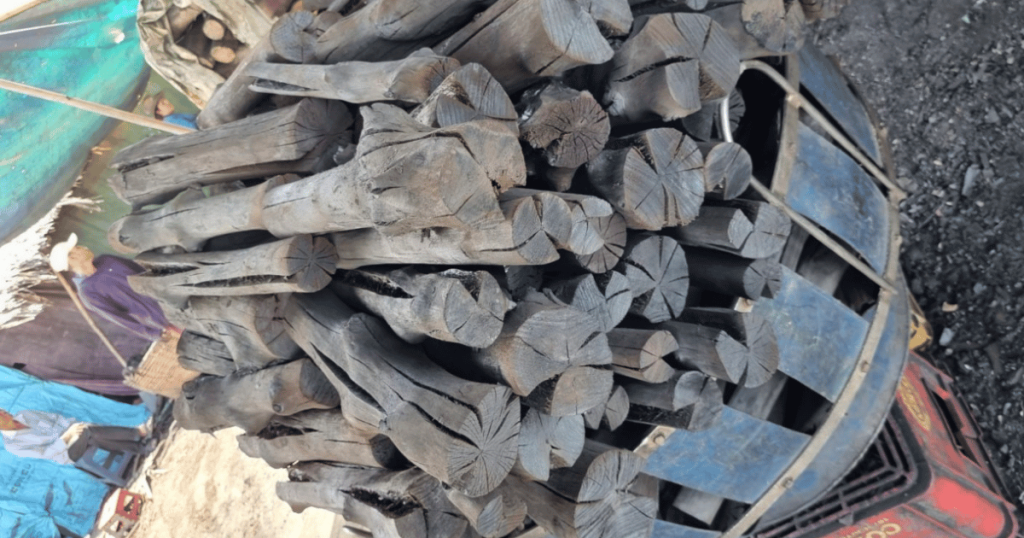
The knowledge of these areas will enable you to have expectations regarding the high quality charcoal. An example of this is lumpwood charcoal, which is richly black in color and irregularly shaped, and this depicts pure carbonization of wood.
Visual check – Color, surface, and dust level
Quite a bit can be detected by a mere visual inspection of the high quality charcoal.
- Color: Premium charcoal is dark black charcoal with a slight metallic lustre on the cut surface. Do not use pieces which are brown in appearance, or whose wood has been seen to be open, for they are only half-carbonized, and will not burn up evenly.
- Surface and Texture: Charcoal of high grade presents itself with a smooth surface and many cracks or dust. Excess dust can imply that the product is easily broken or that it is not transported with care.
- Shape and Size: Even medium-sized pieces that are uniform are less difficult to light and have constant airflow. Big lumps are promising during a long grilling period, and tiny pieces burn too fast.
Sound Test – Knock two pieces together
Another good way of testing the quality of charcoal is the rapid tap test. Take one piece, and beat it against another. Good charcoal burns and creates a clean metallic clink, and this means that the carbonization is low and the moisture is dry. In case the sound is muffled or muted, the charcoal might still have water or unburnt grunts.
Even the weight of the object is worth mentioning. Charcoal is very light relative to its size, which means that all the volatile chemicals of the wood were lost during carbonization.
Weight and density test
The weight and density of charcoal are one of the easiest and most dependable methods to determine high quality charcoal. Premium charcoal will be significantly heavier in the hand when it comes to pieces of the same size. It is a sign of a heavy structure of the wood and successful carbonization of the wood to enable the charcoal to be burned longer and retain consistent heat.
Charcoal of low quality, which is frequently made with soft or mixed wood, is light and porous. It burns fast, its heat is uneven, and it has to be refueled regularly. On a professional level, grilling and industrial, the greater the density of the charcoal, the more it is directly proportional to fuel efficiency, lower consumption, and heating rates, and consistency in cooking performance.
Water test – Sink or float
A water test is a shortcut answer to the quality of charcoal according to its internal density and porosity. High quality charcoal placed in water usually sinks fast, and this demonstrates that it is compact with little internal air spaces.
On the contrary, poor quality charcoal will either float or sink very slowly, which is an indication of over-porosity and under-carbonization. This type of charcoal is generally quick-burning, produces a lot of smoke, and provides inconsistent heat. Although this is not the only method of evaluation, this is a convenient visual type of method that buyers and operators can use to spot dense export-grade charcoal by looking at it.

Safety warning – Risks of low-quality and unknown-origin charcoal
Lower quality or unknown source of charcoal cannot be used seriously because they are very dangerous in terms of safety, health, and use in terms of operation, particularly, restaurants, commercial kitchens, and importers who sell to the professional markets. Although such charcoal might seem cheaper initially, the consequences are usually hidden, and therefore, the consequences can supersede the cost reduction in the short term.
Among the most widespread hazards are unstable combustion and fire. Lowly carbonized charcoal usually has moisture, sap, or trapped gas and will burst into open flames, pop, or even small explosions when ignited. This adds chances of burns, fires, and destruction of grills, ventilation systems, and other related facilities.
Another eminent issue is excessive smoke and toxic emissions. The charcoal prepared using mixed, treated, or unknown wood sources has the potential to emit high smoke, carbon monoxide (CO), and other harmful substances during burning. This poses a genuine threat of carbon monoxide poisoning and chronic respiratory problems to the kitchen staff in enclosed or semi-enclosed areas.
Low-grade charcoal is also prone to the production of both high ash content and fine dust content, which not only contaminates the food but also clogs air filters, lowering the efficiency of the airflow as well as causing an upsurge in the cost of maintenance. In the case of food-service operations, it directly translates to the hygiene standards and customer experience.
Speaking of compliance, the charcoal of unknown origin is imtraceable and untraceable in terms of quality and will most likely fail the food safety inspection during the audit or at the import level. Sourcing certified, export-grade charcoal is not only a good buying decision among buyers and distributors of B2B—it is also an important safety and liability concern.

Top 3 types of high quality charcoal trusted by professional chefs and restaurants
Charcoal is not a fuel in a professional kitchen, steakhouses, and luxury grilling ideas, but it is a key component that influences flavor, heat management, and kitchen safety directly. The three categories of high quality charcoal most reliable among the chefs and restaurant operators around the globe are presented below.
White charcoal (Binchotan) – The king of BBQ
The white charcoal, also referred to as Binchotan, is regarded as the gold standard when it comes to grilling in professional terms. Binchotan has been produced by means of a highly-controlled and high-temperature process of carbonization, which results in superb density, extremely long burn time, and virtually no smoke.
Its capability in ensuring stable and shiny heat makes it a perfect griller in precision, especially in Japanese yakiniku, Korean barbecue, and high-end indoor restaurants. Binchotan has been important to the chefs not only in the performance aspect but also in terms of a clean flavor profile, which enables the natural taste of meat and seafood to shine without the unpleasant smell.
Hardwood lump charcoal – High heat for traditional BBQ
The hardwood lump charcoal is popular in the steakhouses and open flame grills because of its quick start and peak temperature. Constructed with heavy hardwoods, it generates high-density and direct heat and natural flame to add to the classic experience of the BBQ.
High-quality hardwood lump burns at a higher temperature, produces less ash, and is much more predictable in nature as compared to mixed or low-grade charcoal. It is particularly appropriate when searing steak, grilling in an open fire, and relatively short and medium cooking sessions that require extreme heat.
Plantation wood charcoal (Acacia, Eucalyptus) – Best balance of cost and performance
The charcoal made of the plantation woods like acacia or eucalyptus has a good price to availability and performance. These charcoals are good to use in daily restaurant processes because when they are well carbonized, they give consistent heat, average burning time, and low smoke.
Mid-sized restaurants, BBQ chains, and catering services tend to use this kind of charcoal because they need consistent quality in large quantities. Though it might not be as long-lasting as Binchotan, the plantation wood charcoal provides a consistent performance and good cost-effectiveness to be used on a professional level.

How Vietnam Charcoal ensures consistent high quality charcoal
Vietnam Charcoal maintains uniform quality of charcoal by maintaining high-quality raw material, a regulated process of carbonization, and quality control at each production phase. They use only certified wood sources and optimized kiln regimes to produce high-density, consistent output of heat, a low amount of smoke, and low levels of ash.
Grading, moisture inspection, and checking of uniform size and cleanliness are done in every shipment so that its performance in professional grilling and export markets is reliable. Having export-ready packaging and quality control that meet the international standards, Vietnam Charcoal will provide consistent and repeatable quality in each order.
Conclusion
It is not so hard to identify high quality charcoal as it may seem. The black charcoal color, tapping that gives a sharp metallic sound, and simple charcoal tests through burning can be safely used to determine whether the batch of charcoal will give powerful heat and long periods of burn or not. The numerous types of charcoal, especially natural lumpwood charcoal, can be recognized, so you are able to pick the proper product to use in your grill or fireplace.
You can be a backyard barbecue lover or even a restaurant owner; know, by knowing these methods, you can achieve more consistent results and taste. To make sure that you will have your charcoal ready whenever you want to have a cookout, make sure that you have a good supplier of charcoal whom you can trust, and also have your fuel well stored in place so that when the time comes to fire up the grill, you will have high-performance charcoal.

 English
 العربية
 日本語
日本語 한국어
한국어