

Coal vs Charcoal: What’s the Difference and Which Should You Use?
Coal and charcoal look similar, burn hot, and both contain carbon — but that’s where the similarities end. The difference between coal and charcoal matters if you’re sourcing fuel for restaurants, industrial use, or export trade. Coal is a fossil fuel mined from the earth over millions of years. Charcoal is manufactured from wood through controlled burning. They differ in origin, carbon purity, burn behavior, environmental impact, and price. This guide breaks down the coal vs charcoal comparison with real specs and data so you can choose the right fuel for your application.
Coal vs Charcoal: Side-by-Side Comparison
Here’s the quick answer. The detailed breakdown follows below.
| Property | Coal | Charcoal |
| Origin | Fossil fuel — mined from underground deposits | Man-made — produced from wood by pyrolysis |
| Formation Time | Millions of years (geological process) | Hours to days (controlled burning) |
| Carbon Content | 60–95% (varies by type: lignite to anthracite) | 70–90% (hardwood lump: 80–90%) |
| Impurities | Sulfur (0.5–5%), nitrogen, heavy metals | Minimal — mostly ash (1–5%) |
| Burn Temperature | 600–900°C depending on grade | 700–1,000°C (binchotan up to 1,200°C) |
| Smoke & Odor | High smoke, sulfur smell, toxic fumes | Low smoke, clean burn (especially white charcoal) |
| Renewable? | No — finite fossil fuel | Yes — made from sustainably grown wood (FSC) |
| Primary Use | Power plants, steel production, heating | Grilling, BBQ, restaurants, water filtration |
| Cost (bulk) | $50–150/ton (thermal coal, FOB) | $300–1,500/ton (depending on type, FOB) |


What Is Coal? Origin and Formation
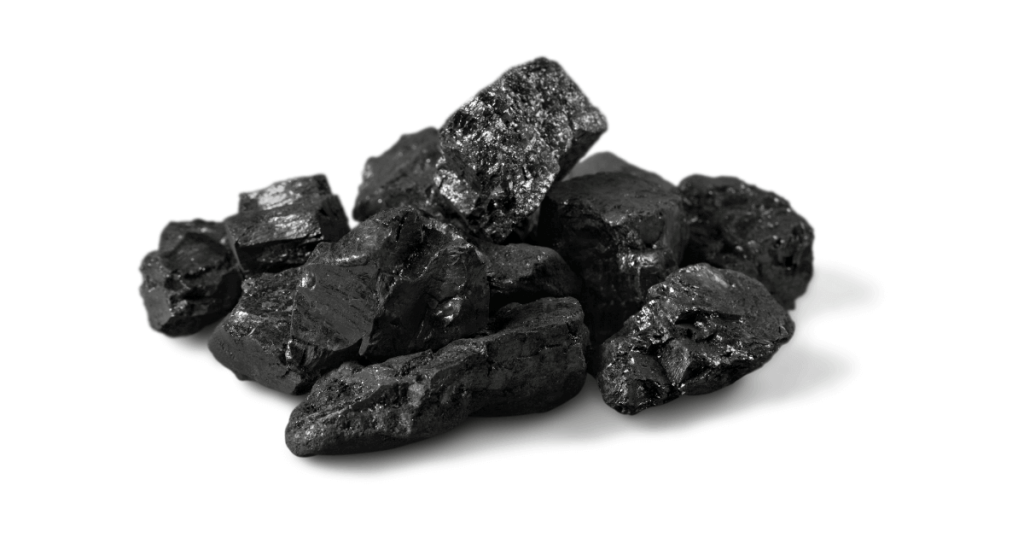
In the coal vs charcoal comparison, coal is a sedimentary rock formed over 300–400 million years from ancient plant matter buried deep underground. Heat and pressure from geological forces gradually converted this organic material into a carbon-rich solid. This process — called coalification — takes millions of years and cannot be replicated artificially.
Coal exists in four main grades, each with different carbon content and energy density:
| Grade | Carbon % | Energy (MJ/kg) | Moisture | Primary Use |
| Lignite | 25–35% | 10–20 | 30–60% | Power generation |
| Sub-bituminous | 35–45% | 20–25 | 15–30% | Power, heating |
| Bituminous | 45–86% | 24–35 | 5–15% | Steel production, industry |
| Anthracite | 86–97% | 30–36 | <5% | Premium heating, metallurgy |
The key issue with coal: it contains sulfur (0.5–5%) and other impurities that release toxic fumes when burned. This makes coal unsuitable for cooking, food processing, or any application where clean combustion matters. Coal is also a non-renewable resource — once mined, it cannot be replaced.
What Is Charcoal? Production and Types
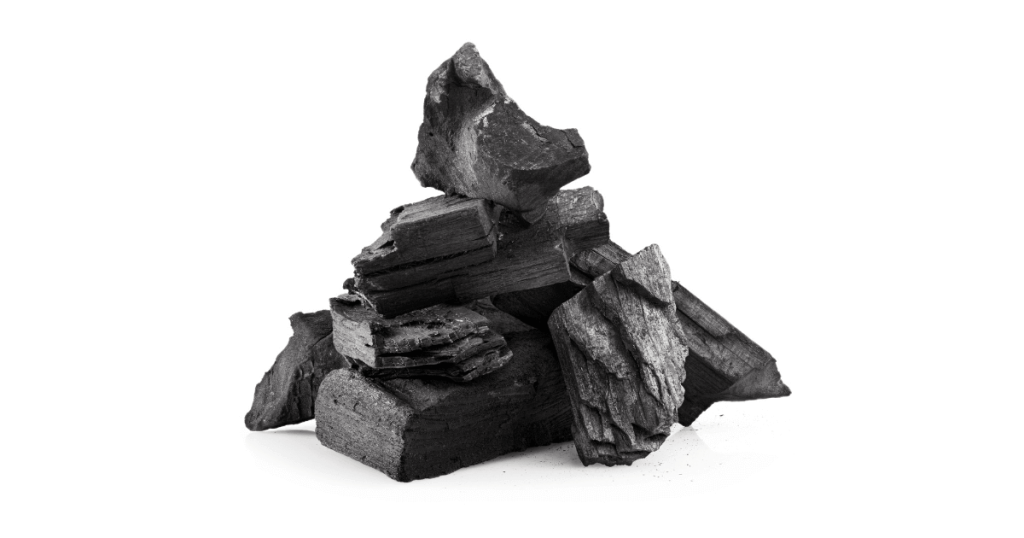
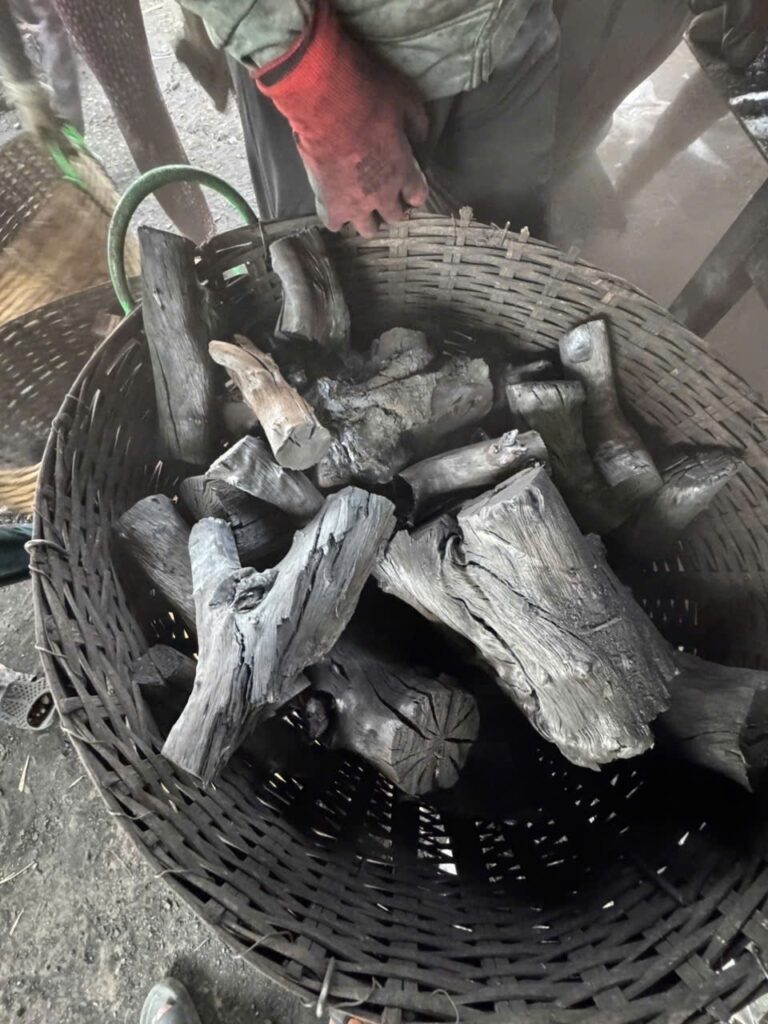
Charcoal is a lightweight, carbon-rich solid produced by heating wood or other organic materials in a low-oxygen environment — a process called pyrolysis. Unlike coal, charcoal is manufactured in hours or days, not millions of years. The result is a porous material with 70–90% carbon content, minimal impurities, and clean-burning properties.
The type of wood and production method determine charcoal quality. Here are the main types used commercially:
Hardwood lump charcoal — made from dense woods like longan, mangrove, or eucalyptus. Burns at 700–900°C with high heat output and long burn time (3–5 hours). Preferred by BBQ restaurants and professional kitchens worldwide. Fixed carbon: 80–90%.
Sawdust briquettes — compressed from sawdust and carbonized. Uniform shape provides consistent heat for 4–6 hours. Popular in commercial foodservice for large-scale grilling. Cost-effective alternative to lump charcoal.
White charcoal (Binchotan) — the premium grade. Produced at temperatures above 1,000°C, then rapidly cooled. Burns almost smokeless at extremely high temperatures. Used in Japanese yakitori restaurants and high-end dining. Fixed carbon: 90–95%. Bamboo charcoal — made from mature bamboo (3–5 years old). Known for its adsorption properties — removes odors, purifies water, and regulates humidity. Also used as grilling fuel with a clean, mild flavor profile.
So is charcoal coal? No. Despite both containing carbon, charcoal is a manufactured product from renewable wood, while coal is a mined fossil fuel. They differ in chemistry, burn characteristics, and environmental impact.
Charcoal vs Coal: Burning Properties Compared
How coal and charcoal burn is the most practical coal vs charcoal difference for any buyer:
Heat output. High-grade coal (anthracite) produces 30–36 MJ/kg. Quality hardwood charcoal produces 28–33 MJ/kg. They’re comparable in energy density, but charcoal reaches peak temperature faster — critical for restaurants that need quick heat-up times.
Burn duration. Coal burns longer per kilogram due to its density. A batch of bituminous coal can sustain heat for 8–12 hours in industrial furnaces. Charcoal briquettes last 4–6 hours, lump charcoal 2–4 hours. For extended industrial processes, coal wins on duration. For grilling and cooking cycles, charcoal is more than sufficient.
Emissions. This is where charcoal clearly wins. Coal releases sulfur dioxide (SO₂), nitrogen oxides (NOₓ), particulate matter, and heavy metals. Charcoal produces primarily CO₂ and water vapor — far cleaner. For any application near food, people, or sensitive environments, charcoal is the only safe option.
Ash content. Coal leaves 5–20% ash depending on grade. Quality charcoal leaves just 1–5% ash. Less ash means less cleanup, less waste, and better airflow during burning.

When to Use Coal vs Charcoal
In the coal vs charcoal decision, the right choice depends entirely on your application, The right choice depends entirely on your application:
Use coal for: power generation, steel manufacturing, cement production, industrial heating, and large-scale energy where emissions can be managed with scrubbers and filtration systems. Coal’s advantage is cost ($50–150/ton FOB) and energy density for continuous industrial processes.
Use charcoal for: BBQ restaurants, grilling, smoking, yakitori, hookah/shisha, water filtration (activated charcoal), air purification, metallurgical applications requiring clean carbon, and any food-contact heating. Charcoal’s advantage is clean combustion, flavor enhancement, and food safety.
For B2B buyers sourcing fuel for restaurants, catering, or food processing: charcoal is the only practical option. No commercial kitchen uses coal — the sulfur emissions, smoke, and toxic byproducts make it unsafe for food preparation. The price difference ($300–1,500/ton for charcoal vs $50–150/ton for coal) reflects this fundamental quality gap.
Coal vs Charcoal Price Comparison for Bulk Buyers
When comparing coal vs charcoal prices, the gap is significant but reflects entirely different product categories. Price is often the first question buyers ask. Here is what bulk pricing looks like across key markets in 2026:
Fuel Type FOB Vietnam CIF Middle East CIF Japan/Korea CIF Europe Thermal coal (tham khảo) $80–150/ton $130–200/ton $120–190/ton $150–220/ton Hardwood lump charcoal $700–800/ton $800–950/ton $750–880/ton $850–1,000/ton Sawdust briquettes $700–900/ton $800–1,050/ton $750–980/ton $850–1,100/ton Binchotan white charcoal $1,000–1,500/ton $1,100–1,650/ton $1,050–1,580/ton $1,150–1,700/ton Bamboo charcoal $700–900/ton $800–1,050/ton $750–980/ton $850–1,100/ton
This coal vs charcoal pricing data is based on 2026 FOB Vietnam rates.
Environmental Impact: Coal vs Charcoal in 2026
The coal vs charcoal debate extends beyond performance and price — environmental impact is now a deciding factor. Sustainability is no longer optional — it’s a purchasing factor for importers and distributors worldwide. Here’s how coal and charcoal compare environmentally:
Coal is a non-renewable fossil fuel. Burning coal is the single largest source of CO₂ emissions globally. Many countries are actively phasing out coal — the EU, UK, Canada, and several Asian nations have set coal exit dates between 2030–2040. For businesses building long-term supply chains, coal dependency carries regulatory risk.
Charcoal can be sustainable — if sourced responsibly. FSC-certified charcoal comes from managed plantations where trees are replanted after harvest. Bamboo charcoal is particularly sustainable — bamboo reaches maturity in 3–5 years (vs 20–50 years for hardwood). When sourced from certified suppliers, charcoal is carbon-neutral This is the clearest environmental advantage in the coal vs charcoal comparison: the CO₂ released during burning equals what the trees absorbed during growth.
For importers concerned about sustainability compliance (especially in EU and Japanese markets), FSC certification and traceable sourcing are essential. Look for suppliers who can provide chain-of-custody documentation.
Frequently Asked Questions About Coal vs Charcoal
Q: Is charcoal the same as coal?
No. Charcoal is manufactured from wood through pyrolysis (heating without oxygen). Coal is a fossil fuel formed naturally over millions of years underground. They have different chemical compositions, burn differently, and serve different purposes. Charcoal is safe for cooking; coal is not.
Q: Can you use coal instead of charcoal for grilling?
No. Coal contains sulfur and heavy metals that produce toxic fumes when burned. These are dangerous near food and harmful to breathe. Always use charcoal — specifically food-grade lump charcoal or briquettes — for grilling and cooking.
Q: Why is charcoal more expensive than coal?
Charcoal requires wood sourcing, controlled carbonization (pyrolysis), cooling, and packaging — a multi-step manufacturing process. Coal is simply mined and processed. Charcoal prices range from $300–1,500/ton FOB depending on type, while thermal coal is $50–150/ton. The price reflects charcoal’s higher purity and food-safe properties.
Q: Which burns hotter — coal or charcoal?
High-quality charcoal (especially binchotan/white charcoal) can reach 1,000–1,200°C, which matches or exceeds most coal grades. Standard hardwood charcoal burns at 700–900°C, comparable to bituminous coal. The difference is that charcoal reaches peak temperature faster and produces far less smoke.
Q: Is charcoal better for the environment than coal?
When sourced from FSC-certified managed plantations, charcoal is renewable and close to carbon-neutral. Coal is a finite fossil fuel and the largest single source of CO₂ emissions globally. For businesses prioritizing sustainability, certified charcoal is the clear choice.
Q: What types of charcoal are best for commercial use?
For restaurants and professional grilling: hardwood lump charcoal (longan, mangrove, eucalyptus) for high heat, or sawdust briquettes for consistent long burns. For premium Japanese cuisine: binchotan white charcoal. For water/air filtration: activated bamboo charcoal.
Q: Can you mix coal and charcoal together?
Mixing is not recommended. Coal produces sulfur fumes and toxic smoke that contaminate food. If you need longer burn time, use charcoal briquettes (4–6 hours) or binchotan (5–7 hours) instead of mixing with coal. For industrial heating where food safety is not a concern, some operations do blend the two — but this is rare and requires proper ventilation.
Q: How do you tell coal and charcoal apart?
Coal is dense, heavy, and shiny black with a rock-like texture. Charcoal is lightweight, porous, and matte black — you can often see wood grain patterns on lump charcoal. The easiest test: charcoal floats in water, coal sinks. When burned, coal produces a strong sulfur smell; charcoal smells like clean wood smoke.
Q: What is the difference between charcoal and coke?
Coke is made by heating coal to 1,000–1,100°C to remove volatile compounds — similar to how charcoal is made from wood. Coke has 90–95% carbon and is used primarily in steel production as a reducing agent in blast furnaces. Charcoal serves a similar metallurgical role but comes from wood, burns cleaner, and is renewable. In Brazil, charcoal-based steel production accounts for roughly 35% of the industry
Source Quality Charcoal from Vietnam
Vietnam Charcoal supplies FSC-certified charcoal products to importers and distributors across Asia, the Middle East, and Europe. Our product range includes hardwood lump charcoal (longan, mangrove, khaya, eucalyptus), sawdust and bamboo briquettes, and binchotan white charcoal. Production capacity: 30–50 containers (40HQ) per month. All products come with phytosanitary certificates, certificates of origin, and fumigation documentation for smooth customs clearance. If you’re evaluating coal vs charcoal for your business, contact us for samples and pricing to see the coal vs charcoal difference firsthand..
- Email: [email protected]
- Facebook: Vietnam Charcoal
- Instagram : vietnamcharcoal.official
- Whatsapp : (+84) 338 218 168

 English
 العربية
 日本語
日本語 한국어
한국어